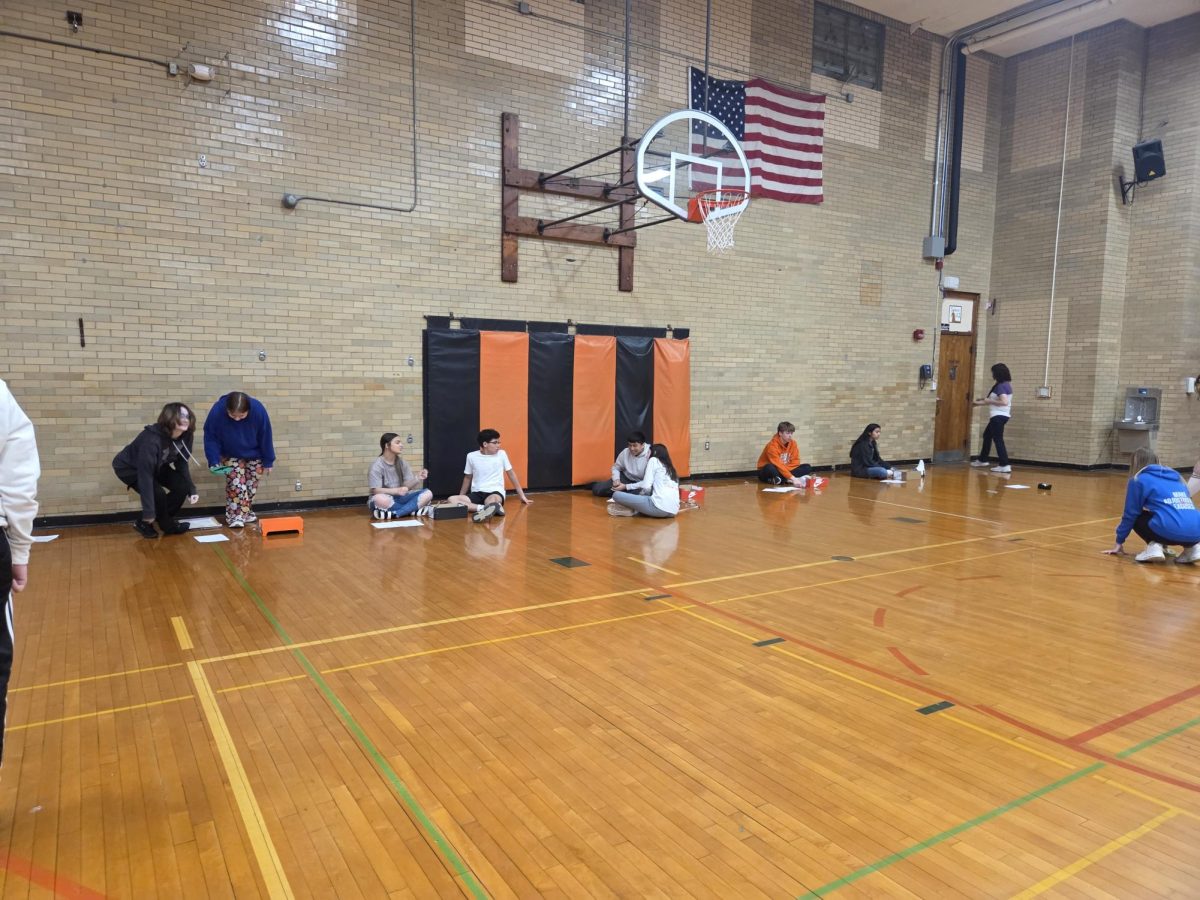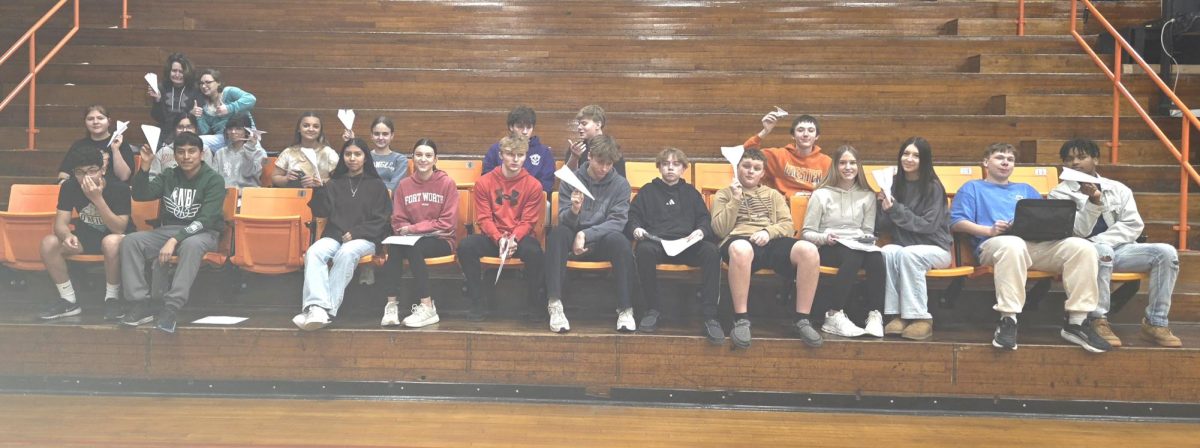
Forget the textbooks and heavy backpacks, freshmen in Mrs. Hankins’s Physical Science classes at Chester High School recently swapped their desks for the open space of Jurgens Gym to turn complex physics into a high-flying competition.
Physical Science classes started working on two new labs. For the first lab, students made an airplane and test‑flew it in three trials. After each trial, they made an improvement to their plane to make it fly farther. For the second lab, students were paired in groups of two for a rubber‑band cannon lab. Students were asked to bring one shoebox for their cannon and then glue a paper to it that had angle measures to show the different launch angles. Students completed four trials at each angle to see how the angles affected distance. Students began test‑flying their planes on February 26 and started firing their rubber‑band cannons on March 5; both labs were done in Jurgens Gym.
Mrs. Hankins, a teacher at Chester High School, was asked why she likes to do these labs. For the rubber‑band cannon lab she responded, “I think the students really enjoy getting out of the classroom and doing fun, hands‑on activities. The hands‑on approach helps students reinforce information they learn in class. The Rubber Band Cannon Lab was to demonstrate centripetal acceleration. All the students seemed to enjoy shooting the rubber bands at different angles.” For the airplane lab she said, “The Airplane Lab is fun and exciting for the students. Who doesn’t like to make a paper airplane and fly it to see how far it can go? The competitiveness among the students helps them design a better plane. Making a prototype, testing it, and then making adjustments to it is a simple way to demonstrate what manufacturers do to get a new product on the market.”
The airplane lab helps students learn how to measure time and distance and convert them into speed (meters per second). This teaches students in a fun way so learning doesn’t feel boring. The goal for the project is to create a plane that can fly the furthest. Students may use only one piece of paper to make their airplane. For this lab, students flew their airplanes and measured distance with a tape measure in meters. They did three trials for each design and recorded notes after each trial describing what happened. They added the three distances and divided by the number of trials to get the average distance (and could then calculate average speed). After completing all three designs and trials, they answered three questions explaining which design was best and why.
The rubber‑band cannon lab helps students develop independent thinking, create a data table, and practice following written directions. The goal for this project is to follow directions and work cooperatively in a group. Students were paired in groups of two and given a paper that guided them through the lab. To complete the lab correctly, students had to read the procedure and all steps to gather the right materials and construct their rubber‑band cannon. If students do not read the instructions, they may complete the lab incorrectly and need to redo it.
These labs show students that science can be hands‑on and fun, not just writing and taking notes in class. They help students step out of their comfort zones, talk with peers they may not have met before, and demonstrate what they have learned in the unit.